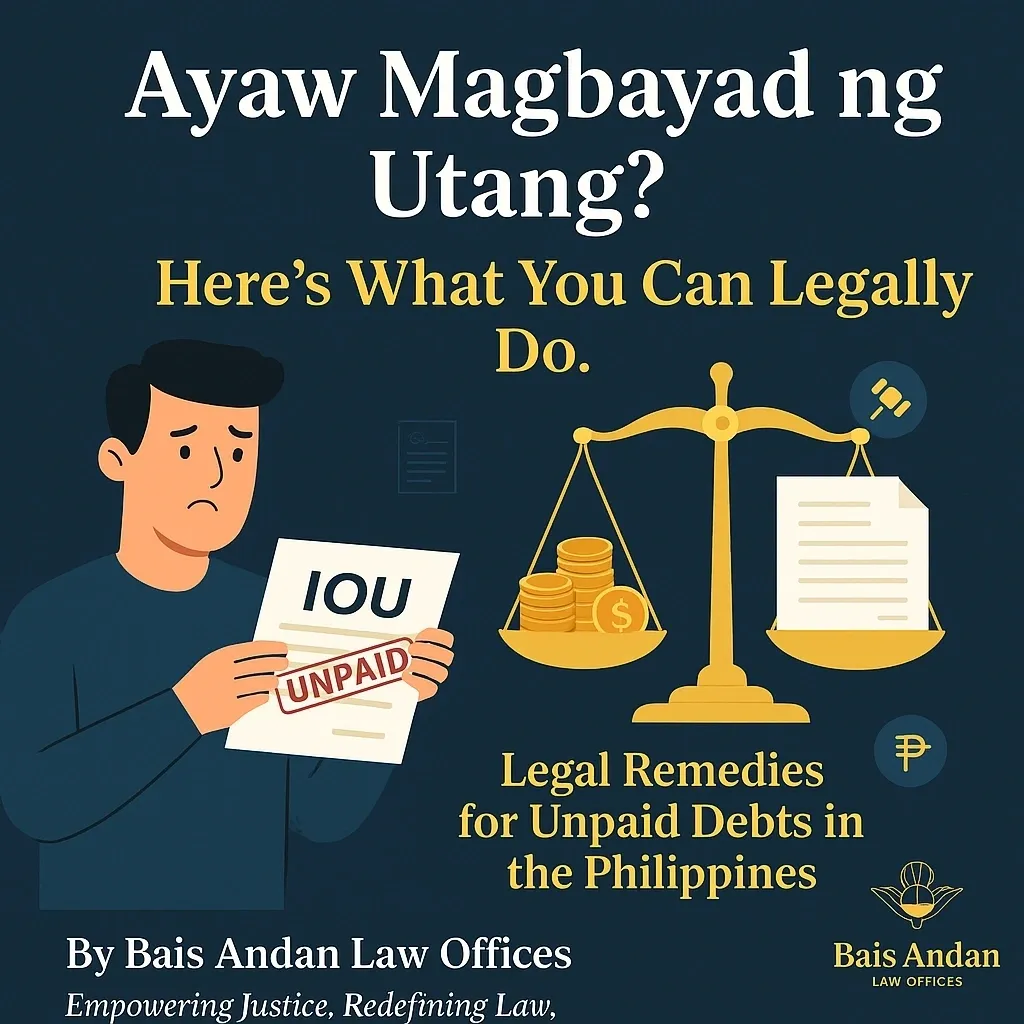
Money disputes are among the most common legal issues in the Philippines. Whether the debt arises from a personal loan, business transaction, or professional service, creditors often ask:
“Pwede ko bang kasuhan ang ayaw magbayad ng utang?”
The answer is yes, but the proper legal remedy depends on the type of obligation and the circumstances of non-payment. Philippine law offers a robust set of remedies for creditors — primarily through civil actions to collect what is due, and sometimes through criminal proceedings when fraud or a violation of law occurs.
1. Demand Letter: The First Step Toward Legal Action
A formal demand letter is more than courtesy — it is a legal prerequisite for establishing delay (mora).
Under the Civil Code, a debtor is considered in delay only after a demand has been made, unless otherwise provided by law or contract.
“Payment shall be made to the person in whose favor the obligation has been constituted, or his successor in interest, or any person authorized to receive it.”
The demand letter should:
- Specify the amount due, the basis of the debt (contract, promissory note, or invoice), and the due date.
- Provide a reasonable payment deadline.
- Attach supporting documents as proof.
Once demand is made and the debtor still refuses to pay, the creditor becomes entitled to legal interest and possibly attorney’s fees, particularly when bad faith is shown.
“If the obligation consists in the payment of a sum of money… the indemnity for damages… shall be the payment of the interest agreed upon, and in the absence of stipulation, the legal interest, which is six per cent per annum.” — Civil Code, Article 2209 “Attorney’s fees and expenses of litigation… may be recovered where the defendant acted in gross and evident bad faith in refusing to satisfy a plainly valid claim.” — Civil Code, Article 2208
A well-crafted demand letter—especially on a law firm’s letterhead—often prompts settlement without court intervention.
2. Civil Action for Collection of Sum of Money
If the debtor ignores the demand, the creditor may file a civil case for collection of sum of money before the proper court. The objective is to obtain a judgment ordering the debtor to pay the amount due, with interest and costs.
Once judgment becomes final, and the debtor still refuses to pay, the creditor may move for execution. The sheriff may then levy and sell the debtor’s personal or real property to satisfy the judgment.
3. Other Legal Remedies for Creditors
Depending on how the debt arose, creditors may invoke the following additional remedies:
a. Foreclosure of Mortgage
If the loan is secured by collateral (e.g., land, vehicle, machinery), the creditor may foreclose the property following the legal procedure. This allows recovery from the sale proceeds of the asset.
b. B.P. 22 (Bouncing Checks Law)
If the debtor issued a bounced check, the creditor may file a criminal complaint under Batas Pambansa Blg. 22.
While the case penalizes the act of issuing a worthless check, its civil aspect ensures recovery of the check’s value with interest.
c. Garnishment of Assets
Upon obtaining a favorable judgment, the creditor may seek garnishment of the debtor’s funds in banks or property held by third parties. This allows recovery directly from the debtor’s financial assets.
Legal basis: Rules of Court, Rule 39.
4. Small Claims for Faster Recovery
For debts ₱1,000,000 and below, creditors may avail of the Small Claims Court procedure.
This process is summary, fast, and affordable, with no need for lawyer representation. The judge decides the case based on documentary evidence.
However, consulting a lawyer before filing ensures proper documentation and stronger presentation.
Small claims are governed by the 2019 Rules on Expedited Procedures for Small Claims Cases (A.M. No. 08-8-7-SC, as amended).
5. Evidence Is the Key to Winning
Courts decide based on preponderance of evidence. Creditors must preserve:
- Signed contracts, promissory notes, invoices, and receipts;
- Screenshots or emails confirming acknowledgment of debt;
- Proof of partial payments;
- Copies of the demand letter and proof of receipt.
As jurisprudence consistently notes, “possession of proof means possession of justice.” Without proper evidence, even a legitimate claim may fail.
6. Legal Interest, Damages, and Attorney’s Fees
Under Article 2209 of the Civil Code, monetary obligations in delay earn 6% legal interest per annum from the date of demand until full payment.
In cases of bad-faith refusal, the creditor may also recover attorney’s fees under Article 2208(5).
Thus, when drafting your Complaint for Collection, always include prayers for:
- Legal interest (Art. 2209);
- Attorney’s fees (Art. 2208);
- Costs of litigation.
Conclusion
Creditors have clear rights under Philippine law — from demanding payment, to filing a civil case, to executing judgment through foreclosure or garnishment.
The best outcomes come from early legal action and proper documentation.
If someone refuses to pay their debt, act within your rights and seek professional advice.
Our firm assists in demand letter preparation, collection cases, foreclosure, and Small Claims actions.
Contact Bais Andan Law Offices
📍 Block 7, Lot 3, Unit B-C, Fil-Am Friendship Highway, Brgy. Cutcut, Angeles City
📍 Magalang Branch – GT Place, O. Gueco St., Brgy. Sta. Cruz, Magalang, Pampanga
📞 0915 968 2503 ✉️ info@baisandanlaw.com
🌐 www.baisandanlaw.com