
In an age where personal information is a valuable commodity and digital transactions are the norm, the concept of privacy becomes increasingly pertinent. Delving into the intricacies of privacy rights and the legal framework surrounding them, the Data Privacy Act (DPA) of 2012 in the Philippines emerges as a crucial document. Let’s explore what the right to privacy entails, how it intersects with modern technology, and the legal protections afforded by the DPA. At the core of privacy lies the fundamental “right to be let alone.” This right is enshrined in constitutional guarantees, including protections for communication, correspondence, and liberty of abode. However, like many rights, privacy is not absolute but subject to limitations, especially concerning public officials and matters of public interest.
The advancement of technology has granted individuals the ability to easily document their daily lives and even the lives of others through videos and photos. Furthermore, the accessibility of surveillance cameras via online shopping platforms raises pertinent questions about safeguarding our right to privacy in today’s interconnected world.
To address these concerns, various legal frameworks provide protections. Section 3 of the Bill of Rights safeguards the privacy of each individual, while the Civil Code and the Data Privacy Act of 2012 provides avenues for recourse in case of privacy violations. Additionally, provisions within the Revised Penal Code and other Special Penal Laws may hold individuals accountable for breaches of privacy, with the courts considering public interest safety in their decisions. Striking a delicate balance between privacy rights and public interest and safety is essential in understanding our privacy rights, particularly in situations where expectations of privacy may be diminished.
In this article, we will explore the Data Privacy Act and how it protects our privacy.
An Illustration
Consider the intricacies of a social media giant like Facebook. Upon joining the platform, users willingly furnish personal details such as their name, email address, and date of birth. Armed with this information, Facebook crafts a comprehensive profile, enabling tailored content delivery, personalized advertisements, and even suggesting connections based on shared interests or mutual friends.
While Facebook’s algorithmic prowess undoubtedly enhances user experience, it also raises pertinent privacy concerns. For instance, the platform’s ability to discern user preferences based on their interactions with posts can lead to targeted advertising or recommendations for relevant groups or events. While this functionality can be perceived as a convenience, some users may feel a sense of intrusion as their digital footprint becomes increasingly predictable.
However, the line blurs when Facebook ventures into sharing user data with third-party advertisers without explicit consent. Such actions would undoubtedly breach privacy norms and legal regulations governing data protection. Furthermore, any lapses in Facebook’s security protocols, leading to a data breach and subsequent exposure of users’ private information, would trigger severe legal repercussions and undermine trust in the platform’s ability to safeguard sensitive data.
This example underscores the delicate balance between personalization and privacy in the digital realm. It emphasizes the critical need for transparent data practices, stringent privacy policies, and robust security measures to uphold users’ rights and protect their sensitive information from exploitation or unauthorized access. As technology continues to evolve, ensuring the ethical and responsible handling of personal data remains paramount in preserving individuals’ privacy rights and fostering a trustworthy digital ecosystem.
The Data Privacy Act
Enacted as Republic Act No. 10173, the Data Privacy Act of 2012 serves as the cornerstone legislation in the Philippines concerning the protection of personal data. It outlines clear guidelines for the processing of personal information and imposes penalties for its mishandling.
The DPA defines personal information broadly, encompassing any data that can directly or indirectly identify an individual. This includes information like names, addresses, and even preferences. While some data may seem innocuous, others, like dates of birth coupled with other details, warrant heightened protection.
Extending Jurisdiction Beyond Borders
Importantly, the reach of the Data Privacy Act extends beyond Philippine territory. It applies to entities or individuals with offices or equipment within the Philippines and encompasses the processing of personal information of Philippine citizens, regardless of their geographic location.
Protecting Personal and Sensitive Information
The DPA safeguards two main categories of information: personal information and sensitive personal information. Personal information includes data that can directly or indirectly identify an individual, while sensitive personal information encompasses more delicate details such as race, health, and religious beliefs.
Activities Regulated by the Data Privacy Act
The DPA governs all forms of personal information processing, from collection and recording to modification, retrieval, and even destruction of data. It mandates that processing must serve a declared, specific, and legitimate purpose and requires obtaining consent from data subjects beforehand.
Personal information encompasses any data, whether recorded or not, that directly or indirectly reveals the identity of an individual. This includes a range of details such as:
- Demographic factors like race, ethnicity, marital status, age, color, and religious, philosophical, or political beliefs.
- Sensitive information pertaining to health, education, genetic makeup, sexual life, or involvement in criminal proceedings, including sentences or disposals.
- Identifiers such as social security numbers, past or present health records, licenses, tax returns, or any data specifically marked as classified by Executive Order or Congress.
Exclusions and Exceptions
Despite the broad scope of the DPA, certain exemptions exist, and is not protected under the law. These are:
- Details about current or former government institution officers or employees, relating to their roles or duties, such as:
- Confirmation of employment status.
- Work-related contact information.
- Job classification, salary range, and responsibilities.
- Name on documents generated during government service.
- Information concerning individuals providing services under contract for a government institution, encompassing contract terms and the name provided during service.
- Information about financial benefits provided by the government, like licenses or permits, including recipient names and benefit specifics.
- Personal data used for journalistic, artistic, literary, or research purposes.
- Data essential for public authority functions, including processing by independent monetary authorities, law enforcement, and regulatory agencies, while respecting existing laws like the Secrecy of Bank Deposits Act, the Foreign Currency Deposit Act, and the Credit Information System Act.
- Information needed for banks and financial institutions under the jurisdiction of the central monetary authority to adhere to anti-money laundering laws and other applicable regulations.
- Personal information initially obtained from foreign jurisdiction residents under their respective data privacy laws and processed in the Philippines.
Rights of Data Subjects
Under the DPA, data subjects enjoy various rights, including the right to be informed, access, rectify, control, and complain about their personal information. These rights empower individuals to have greater control over their data and hold organizations accountable for data protection.
Consequences for Violating DPA
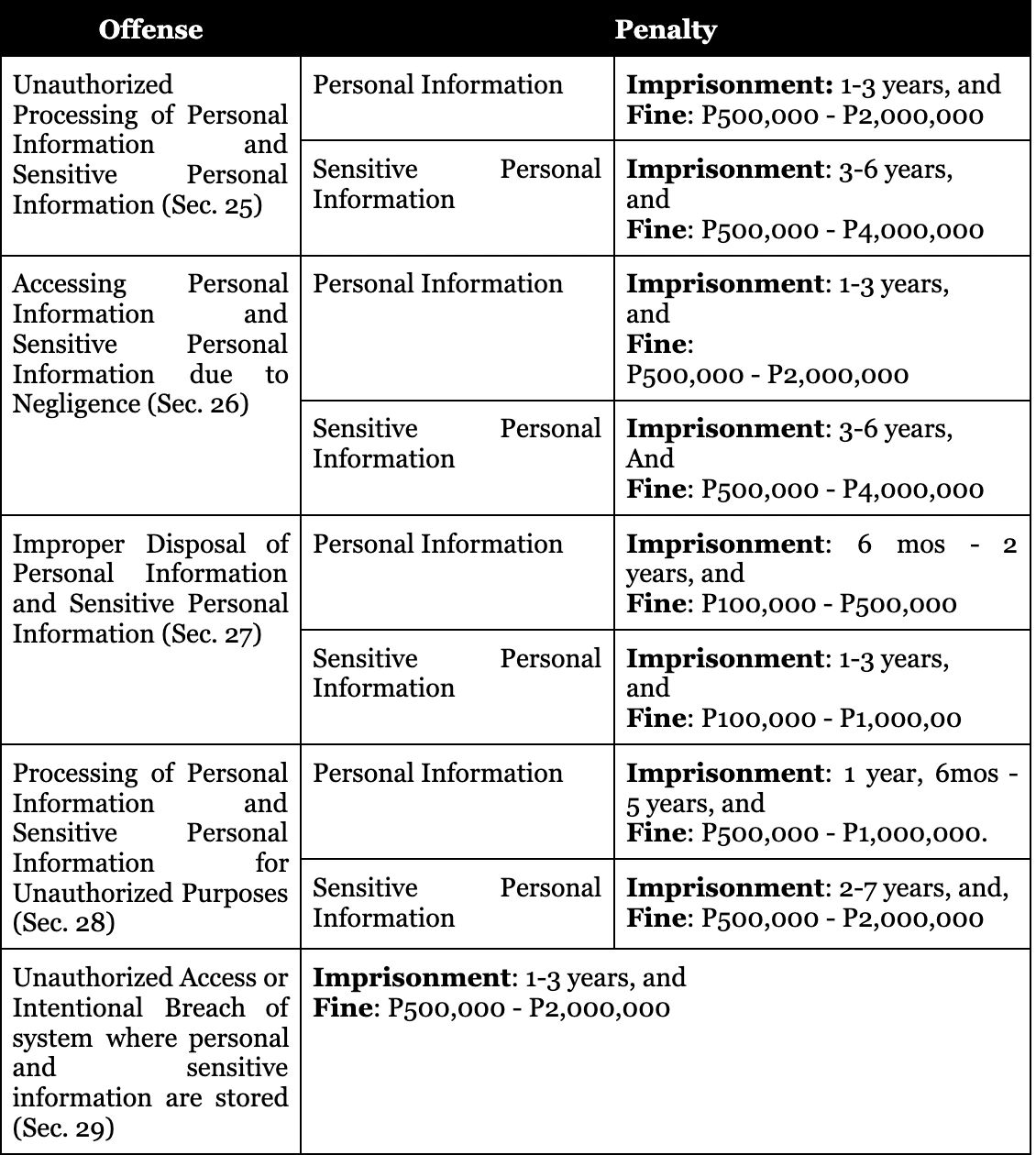
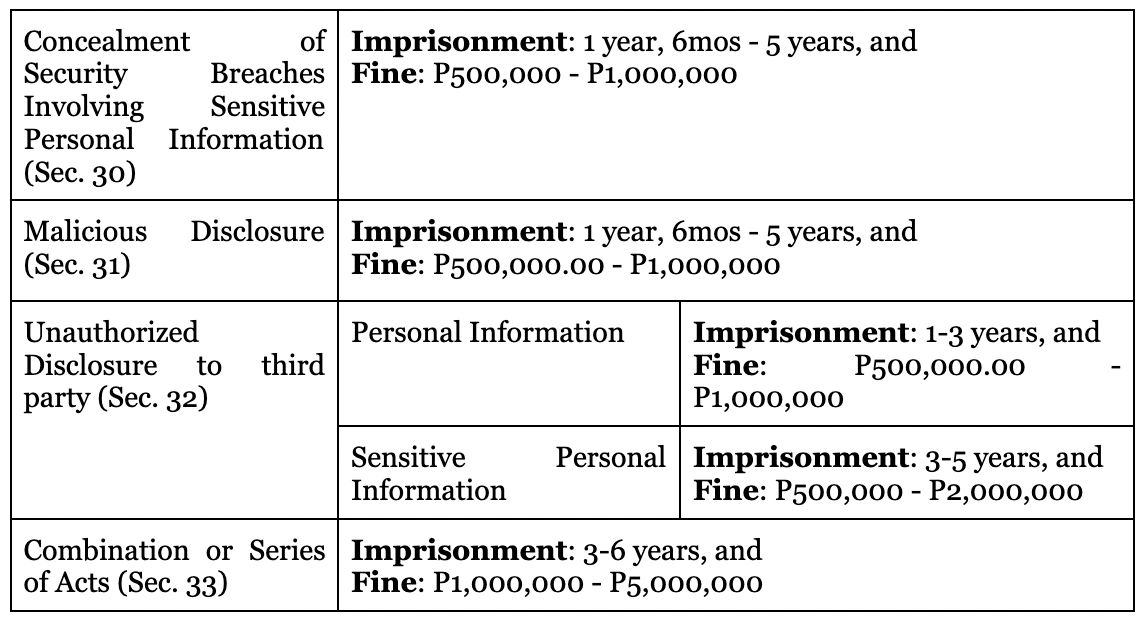
The stakes are high when it comes to safeguarding personal information. The DPA imposes strict penalties for breaches. Such breaches not only violate privacy rights but also expose individuals to various risks, including identity theft and fraud. The following table summarizes the offenses under the law and their corresponding penalty.
Jurisprudence and Balancing Acts
Legal precedents further elucidate the complexities of privacy rights, particularly in the digital realm. While privacy is vital, law enforcement agencies may require access to certain data for investigative purposes.
In the case of Disini vs. Secretary of Justice, it delineates a delicate balance between two seemingly conflicting principles: the fundamental rights of individuals and the interests of justice and the public, which may encompass the rights of others. Undoubtedly, privacy is indispensable to the fabric of a democratic society and the functioning of our government and economy. The ability for citizens, governments, and businesses to deliberate and make decisions privately is essential, shielding them from undue scrutiny. This imperative for privacy extends to electronic contexts, where social, governmental, and economic transactions increasingly occur.
Simultaneously, law enforcement agencies must possess modern tools to combat criminals who exploit electronic technology, safeguarding society and the economy. The inherently public nature of the Internet and traffic data undermines any reasonable expectation of privacy. Data disclosed to the public sphere carries inherent risks, and individuals must accept responsibility for such disclosures. This principle finds support in the landmark U.S. Supreme Court case, Smith v. Maryland, where it was ruled that individuals have no legitimate expectation of privacy in data voluntarily exposed to the public. In line with the Cybercrime Prevention Act, traffic data is explicitly limited to non-content and non-identifying information, thereby falling outside the scope of constitutional protection. Therefore, it is evident that traffic data itself does not enjoy constitutional safeguards against intrusion.
The distinction between content and non-content data is pivotal, with only content data receiving constitutional protection. Pen registers, which capture non-content data, were deemed permissible by the Court in Smith, as they do not intercept communication contents. Similarly, non-content information such as envelope details in traditional mail or traffic data in electronic communications are not constitutionally protected. However, recent rulings, like in Warshak v. United States, highlight a heightened privacy interest in email content.
In the case of Lagman v. Medialdea, it was noted that the DPA, permits the collection, recording, and utilization of personal information without the consent of the individual in certain circumstances. These circumstances include responding to national emergencies, ensuring public order and safety, and fulfilling public authority functions, as mandated by the National Privacy Commission.
Conclusion
In conclusion, DPA stands as a crucial legal framework in the Philippines, addressing the complexities of privacy rights in the digital age. Rooted in constitutional guarantees, privacy rights are subject to limitations, especially concerning public officials and matters of public interest. Legal precedents highlight the delicate balance between individual rights and societal interests in the digital realm. Upholding transparent data practices and robust security measures is essential for protecting privacy rights and fostering a trustworthy digital ecosystem.
In light of these legal considerations, it is incumbent upon social media users to exercise prudence regarding the privacy rights of others. Individuals should refrain from inadvertently capturing or sharing personal information without consent. Obtaining explicit consent before posting images or videos featuring other individuals demonstrates respect for their privacy and promotes responsible online behavior.
Bais Andan Law Offices is dedicated to assisting you in protecting your privacy. Our team of lawyers can offer guidance on how to proceed with your case and assist you in navigating the intricacies of our legal system. Contact us today at info@baisandanlaw.com or call us at 0915 968 2503 or (045) 281 0164.